Friday, September 20, 2013

Correct Practice


Student: Sensei, how do I hit the target every time?

Sensei: You practice hitting the target, every time.

I saw this meme floating around, and the quote, the saying, in it reflects how one should practice.

There's another saying that you probably have heard as well, it is better to practice one technique a thousand times rather than a thousand techniques once. However, this saying has been taken to meant repetitions. If it's only merely repetitions, then it is not enough even if you do it a million times. Why is that so? Practicing something that is wrong a thousand times won't make it right, it will just mean that you become good at doing the wrong thing.

In Japanese budo there are 3 words that you usually hear which in English are all taken to mean "practice" or "training":

  • Keiko (稽古)
  • Shugyo (修行)
  • Renshu (練習)

Keiko literally means "tracing the old". This is a part where one sees how the elders do it and replicate it. Replicating not merely in form, but in totality, the process and outcome. In the eastern arts, the end does not justify the mean. One must follow the process in order not to miss important details that are not visible in the outcome. In the east, the arts are process based, not result oriented, though the results are clearly visible.

The only way to quickly get results is to go through the process diligently and correctly. Tracing the old is not merely copying, but understanding why your predecessor could achieve results through the given process. As the word suggests, you have to have something to trace to, a point of reference. This part is saying that you will be under the guidance of, receiving instruction from, somebody that is more senior. Even though you are doing self-practice (独稽古) or free-practice (自由稽古) the guidance is still there, in the form of what you have traced previously from your elders/seniors.

Shugyo could literally mean conducting self discipline, mastering oneself. This is usually related to spiritual or even ascetic practices. This is used for budoka as well because they are seen in the process of achieving enlightenment. A budoka is even sometimes called a shugyosha (somebody that practices shugyo). This is a part when one practices religiously, being really serious about the discipline that one is studying. It is not merely self-practice. If we could see spiritual shugyo of Buddhists or Shinto practitioners, for example, it takes dedication, not merely a 2-3 minute meditation. The same could be said for budo.

This is the further exploration of your keiko, it is more than just self practice, but you really do it to achieve understanding of what you have learned. In budo, the only way to really understand it is to experience it (taitoku). Finding out the correct process, practice it, experience it, have the discipline to train in it.

Renshu is the part that do actually mean training, practice, or repetition. This part is where one repeats everything that one has learned and experienced. This needs to be done correctly based on one has received through keiko and shugyo, this is the part where one practice hitting the target each time, doing the repetition correctly.

The three terminologies are not interchangeable but they are connected, as there are philosophies behind the words used, and each aspect of practice includes all of them.

Don't let this confuse you. Just forget about it, and keep training...


Tuesday, August 6, 2013

Disparity of Force

I came across the terminology "Disparity of Force" in a clip of Massad Ayoob explaining "Stand Your Ground Law" that was posted by Marc MacYoung on his FaceBook page. Before we continue, you might want to listen to the below 16.5 minute clip and get an idea what the terminology means.


I'm not here to discuss about Gun Control, Castle Law, or even Stand Your Ground Law, as they are actually irrelevant to where I am right now, Indonesia. Here in Indonesia, civilians don't have the right to have firearms. There was even a time having bladed weapons could get you into serious trouble. The only people that have firearms are police officers, military, and the bad guys, including terrorists. So this won't be the topic of this entry. But at a personal level, if you do practice martial arts then I think you should try to familiarize yourself with all types of weapons, ancient or modern.

The Disparity of Force is an important concept that all those who practice martial arts and self defense understand. As explained in the clip, the Disparity of Force is when one has a clear advantage of dominating the other person, by means of weapons or not. A bigger person may clearly be able to beat a person of a smaller size to death, or an abled body person beating the life out of a handicapped person, is a Disparity of Force, though the person is unarmed.

As we've discussed before, if we talk about martial arts we are talking about warfare, which it's either you kill or be killed kind of battlefield situation, and you do want to have the upper hand at all times in order to be able to execute this. Even when your opponent is disabled, you are going to "finish the job". Warfare has a different rule than self defense in a civilian setting.

In the civilian setting, it is not that simple. I see this as people that are actually defending themselves become the attacker because they simply don't know the lines when to stop. You may be the person that is initially being attacked, but you are maybe skillfull or lucky, you were able to get the upper hand or somehow disable the initial attacker, but you proceed on beating the guy perhaps to the point of death. In this case, you will need a very good reason why you did it. Or the tables are turned, fearing for his life, the initial attacker actually killed you instead, and he could actually get away with claiming self defense.

I am not familiar with the law down here, but it is usually vague at best. We have pick pockets or robbers lynched mob, humiliated, killed, burned, and not one of those mobs got prosecuted or even arrested. So maybe those lines are ignored here, especially if it's too difficult for the police to investigate, and they don't want to be unpopular by sympathizing with the thief rather than the mob doing their brand of "justice". A lynch mob is clearly a  Disparity of Force, and by right I should be able to defend myself or retaliate using lethal force, but that may not be the case here.

Going away from that as Indonesian Law is not my forte, and should be discussed with somebody that has more expertise in the subject matter.

This entry is just a word of caution to fellow practitioners out there to know their boundaries. Just because the tables are turned and you are having an advantage over the initial attacker, now that person who was attacking will start claiming self defense and get you into trouble with the law. We heard stories of people fighting, and the person that initiated the fight in turn claimed self defense. Which is a lot of crap, but if that person knows how to manage the situation better than you, then you will be on the short end of the stick and going to jail or at least sued. You will need to understand martial arts and self defense in the civilian context. 


Sunday, July 7, 2013

The Tenth Man


One thing that stuck with me in this movie is "The Tenth Man" principle, that goes like this:

"If nine intelligence analysts came to the same conclusion, it was the duty of the tenth to disagree. No matter how unlikely or far-fetched a possibility might be, one must always dig deeper."

I see this as an antithesis to Occam's Razor, where one shouldn't overcomplicate things and try to find the simplest answer. The Tenth Man is supposed to find out the most unlikely answer.

I don't know of this is an actual principle in warfare or if this was just made up in the novel, this could be applied in think tanks and brainstorming sessions. This is actually a way to think out of the box. That's why opinions should not be immediately dismissed as there may be some merit in it.

When the whole team agrees on a conclusion, they could get blindsided. So there should be someone that could explore the other possibilities, even if that person doesn't believe it. 

If a decision was based on 99% certainty, then someone will need to explore the 1% uncertainty. In risk management they usually call this stress testing. But even with this, The Tenth Man must challenge the results and go further. A devil's advocate, if I may say so.

The Tenth Man is not actually economical in a business sense, because it could end up as a witch hunt or a wild goose chase on a theory that doesn't make sense in the first place. I guess not many will resort to this, but it is a good method of going beyond the normal thought process.

In budō, this may have relationship to shu-ha-ri (守破離), especially the ha (破) part.


Saturday, July 6, 2013

黙想 (mokusō) - silent thoughts


The generally accepted translation mokusō (黙想) is "meditation", but this translation confuses me as I can't get a grasp of what the word "meditation" really is. The first kanji tor mokusō is "silence" and the second part is "thought", so by looking at this I could take mokusō to mean "silencing one's thoughts" or "silent thoughts". Approaching it this way could give me a better idea of the goals of this particular practice (in this case, shugyō - 修行).

How do one silence one's thoughts? Is it by telling it to be silent? Forcing it into silence? A friend of mind did make a good point on this, suppressing one's thought is not the same as silencing one's thought. The reason being the action of silencing one's thought becomes another noise, so this noise becomes a suppressant because it's trying to be louder than the other thoughts, drowning them.

Of course, most people are familiar with Jedi Master Yoda's saying, "Try not. Do or do not. There is no try."

Don't try to be silent, don't force it, just be without being.

Though the understanding of mokusō is more of a process, as mushin no shin (無心の心), the mind of no mind, mokusō is also a state of being.

No mind does not mean the absence of mind or a mind that wanders. It is a state of mind that is not a relative mind, the true mind. As the silent thought is the true thought, immovable, uncorruptable.

Ideas such as this is a difficult concept to grasp and leads to over-thinking and over-explanation. This too only a theory of mine, as in taitoku, I have yet to truly experience this to have the right explanation and even if I did, I wouldn't know how to put it into words.

As I often close these types of blogs, I usually quote the following:

To think about not thinking, is already thinking.

It is better not to think about not thinking at all.


Friday, July 5, 2013

体得 (taitoku) - direct experience

My Japanese language class method of teaching is interesting. The teacher doesn't or is reluctant to translate words or sentences into our language (Bahasa Indonesia), instead they show it using graphics and motions or pointing it out and have us do the same.

At first it's a bit difficult, but then I'm actually picking it up faster than the Japanese language classes I had in the past. Then it clicked, this is taitoku (体得).

Taitoku literally translates to "(the) body getting (it)" or less literal is "learning through the body"; the dictionary translation is "experience" or "mastery".

Learning budō (武道) is the same thing... but I think much of how the Japanese teach things are pretty much using the same method, learning by doing. You have theories and classrooms, but in the end you will need to practice what you learn with a guidance of a teacher or senior. One can learn a lot from a classroom, make theories, etc. but if one doesn't practice, then it's pretty much pointless.

In budō, taitoku the meaning could be taken both ways. One uses ones own body to experience the techniques and movement, feeling it as they are applied through our own body. Theories are fine, musings are alright, discussions are allowed, but at the end of the day you have to "put your money where your mouth is". Talking about it won't make you understand the concept any better, you must do!

There are tendencies of over-explanation and over-thinking nowadays because these things look illogical to our somewhat "academic" mind. It is illogical because we haven't experienced it, the logic has yet to exist in our mind.

The same when learning language. We tend to discriminate with the logic that we know about our own language or other languages we know. We tend to try to identify one thing with another that have a different background. To avoid this, the teacher doesn't do much translating, instead have us practice using it immediately, regardless whether or not we understand at that point of time. With frequent use in the correct manner, we understand what it means and how to use it though we may not be able to correctly translate it into our own language.

With budō over-explanation or over-thinking of things will leave one with a cluttered mind. These explanations or thoughts are of other's personal experience put into words in manners the person know how, it may not be the actual experience itself. In order to know one has to go through the same experience.

In saying that, this blog is one of those over-explanations/thinkings mentioned above, so don't take my word for it as this is my personal experience.

If one has to explain what a rose is to a person that has never seen, smell, feel a rose, how could one do that? One could only try to make analogies using things that the person has experienced before, but it is still not the actual rose, just an analog of secondhand information. If the person wants to know what a rose truly is, then that person will need to see, smell, feel the rose directly.

This is taitoku, if you want to know then you have to experience it directly.

Saturday, May 4, 2013

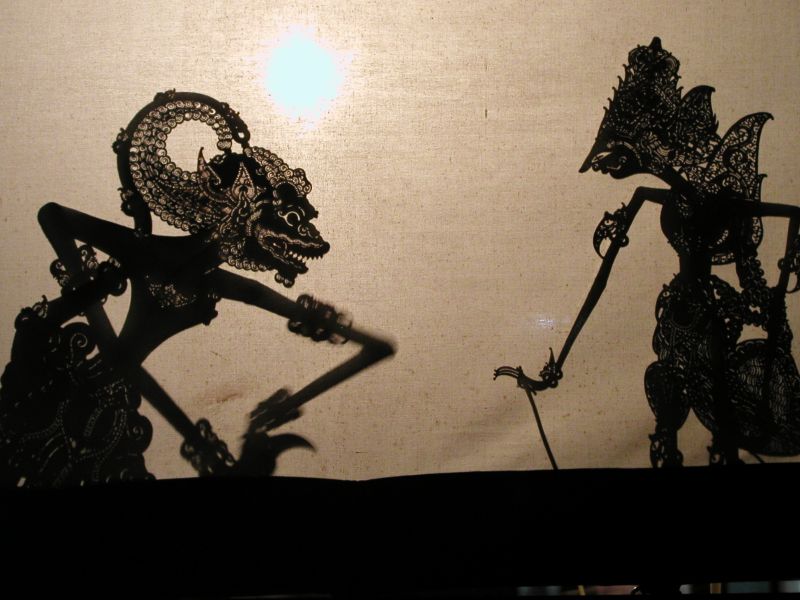
Wayang (影人形)


Am I just poorly imitating shadows of a history long gone?

Sometimes I think that I'm just doing budō (武道) or bujutsu (武術) without understanding the context pf what it was and or what it's supposed to be; "making it up as we go along," they say.

Why do I say this? I say this because I do think that nowadays budō has been taken out of context and the reason is that we are living a relatively comfortable life and budō may not be so relevant to our daily life anymore. So what do we do? We modify it to conform to what we are comfortable with.

It is undeniable that bujutsu and its philosophical counterpart, budō, was born out of warfare and violence therefore it is also important to understand its culture and history. This is the part many forget, don't know, or don't care and end up having a skewed perception of budō.

I always say that there is an evolution to budō and we do need to understand the process, not just what we see/hear/feel/think what the end product is. The history of violence is undeniable, bujutsu/budō was forged in battle, quenched in blood, and tempered by will, things that many so called practioners get to see.

I am not criticizing anybody, just merely stating my observation. I am not saying it is wrong to practice martial arts the way people do nowadays as long as they understand the context and the purpose of their practice and not have any illusions of grandeur. In the the modern life, budō and bujutsu have become irrelevant. People do not need to pick up a sword and go to battles everyday.

Then again, I may be unfair to say that because there are still war torn countries and areas as we speak, who people when they sleep at night may not have a chance to wake up the next morning. Have we ever thought of ourselves in that position? Would our training be relevant then? What is the purpose of our training any way? Self defense?

Self defense is another complex issue. Self defense is not black and white, it is a multitude shades of gray. Violence in this modern civilization is complex as well. Social norms have changed with time, what once was acceptable may no longer be. It is important to understand this and see if our training is also relevant.

Why did I title this blog as "wayang" or shadow puppet? When watching a wayang show, all you see are shadows, black figures over a white screen. The puppet itself is actually an intricate piece of work, how it is made is not as simple as the shadow we see.


In a shadow play, it is not a silent movie, there are music and narration to describe the movement and the story. If you don't understand the language then you won't know the story. As it is in usually Javanese, I don't know as well.

Because I don't know the language or the story, then I start making things up of what the shadow represents and then re-tell this story to others, with a half-assed wayang skill, taking everything out of context. But, as I may be the only one that has seen it from the group I'm showing it to, they believe me and others start doing the same thing.

So what am I saying? It is the question I asked in the beginning of this blog, am I just poorly imitating shadows of a history long gone?

To me, keiko (稽古), tracing the old, is important to understand the context of training, its culture, its history, why it is done the way it's done.

Each exercise and technique has a story to tell, it has a history of how it was developed and even to understand this one may need to have a cultural context of the time.

Tracing/researching this is not everybody, it takes effort, time, and dedication, and some is alright with just imitating shadows. Again, nothing wrong with that, as long as you understand that you are only imitating shadows and may not even be a good imitation either.

It is alright to do martial arts for fun as long as you realize that it is only for fun and may not give you an actual martial skill. Taking things out of context could be fatal because it will give you an illusion of understanding.

One cannot just take the meaning of the kanji "bu" (武) as "stopping the spear" without understanding how to gain the skill rooted in "carrying/using the spear". Taking this kanji out of context would make one think that it philosophically mean pacifism, which clearly it is not... not even close, is not only naïve but could potentially be dangerous.

Saturday, April 20, 2013

Are we moving towards a dystopian society?

In stories such as 1984, Big Brother was in the form of an overseeing government over its people. Then we have other stories of dystopian societies such as Fahrenheit 451 and more recently Equilibrium where the people participated and take part of being the Big Brother themselves.

This view is becoming more true. With social media and all, we are actually reporting our activities voluntarily for others to see, not just having others reporting us.

Sharing of personal information has somewhat become a necessity for some communities, real or virtual. Though some would say that what they post is limited, a profile could be derived from your behavior on the Internet, albeit real or perceived.

Usually, in the story, a dystopian society usually comes with a draconian law. In the story it is imposed by the government, however it seems that it is more and more requested by the society itself, knowingly or unknowingly yhe consequences that may befall them in the future state.

One side of the society wants to impose a set of laws, the other side disagrees but they have another set of laws they want to impose. Both sides accuse each other of trying to brainwash society. They both arise from fear. Whoever wins, everybody lose, and a draconian government will be established over a dystopian society.

Whichever side won, they would think they finally have what they want, but they have yet to realize the cost that they have to pay. When you read this, you would probably nod your head and think that it is the other side that will be guilty of the downfall, but you may be no different, you may also be guilty of the downfall but in another form, the form that you agree with.

Whichever side you're on, you will probably end up the same, unless you can think differently, beyond the relative truths that you are so accustomed to.

http://en.m.wikipedia.org/wiki/Dystopia

http://en.m.wikipedia.org/wiki/Draco_(lawgiver)

http://en.m.wikipedia.org/wiki/Nineteen_Eighty-Four

http://en.m.wikipedia.org/wiki/Fahrenheit_451

http://en.m.wikipedia.org/wiki/Equilibrium_(film)